


What is semaglutide, and what is compounded semaglutide?
Semaglutide is a GLP-1 medicine. It is sold under brand names made by Novo Nordisk, each FDA-approved for its own uses:
Wegovy (weekly injection) and the Wegovy pill (daily tablet): weight management in adults with obesity, or overweight and a weight-related condition, and reducing the risk of major cardiovascular events in adults with established cardiovascular disease and obesity or overweight.
Ozempic (weekly injection) and Rybelsus (daily tablet): type 2 diabetes.
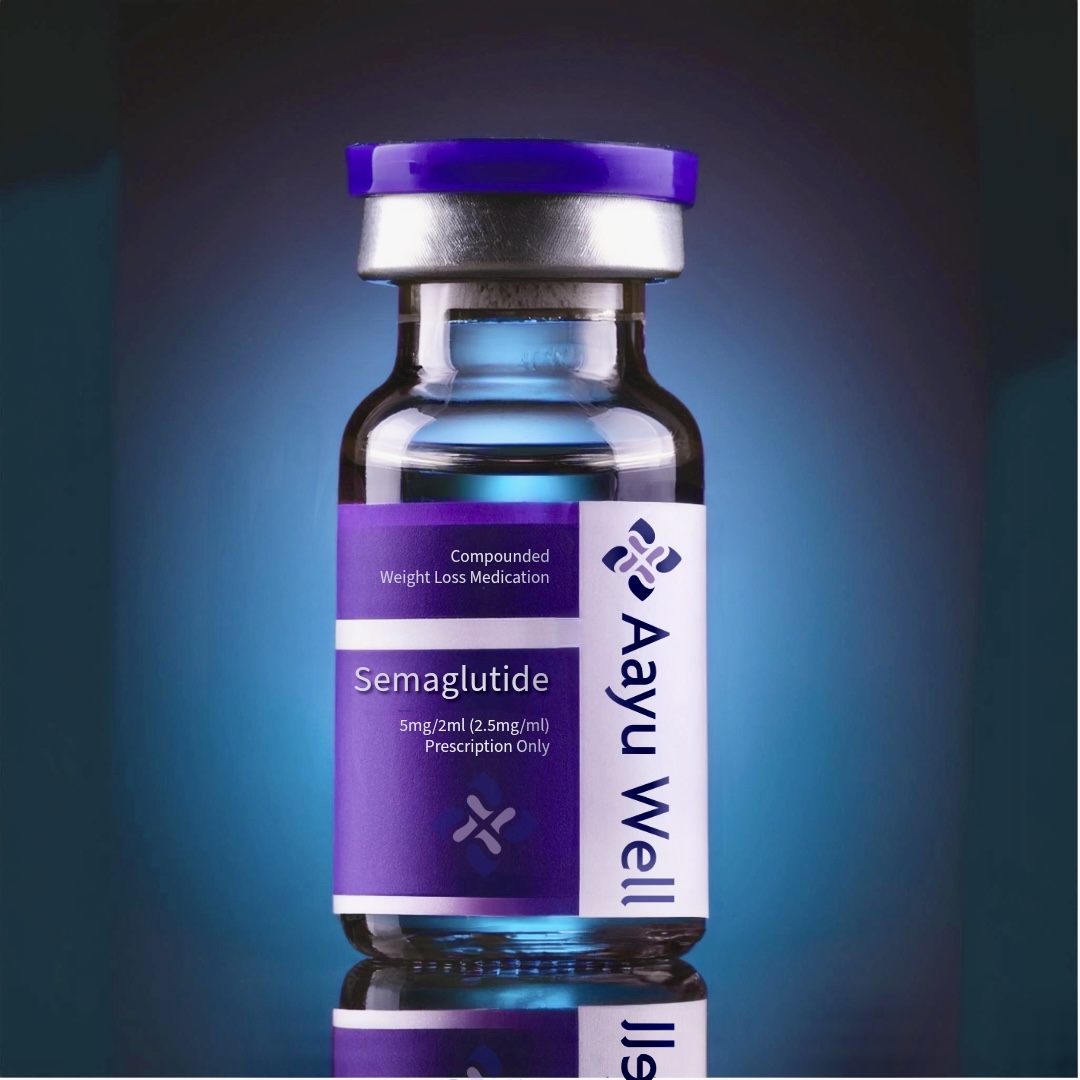
Compounded semaglutide is different. Aayu Well prescribes it when it is right for the patient, and it is prepared for you by a state-licensed pharmacy in the dose your physician prescribes.
Compounded medicines are not FDA-approved and are not reviewed by FDA for safety, effectiveness or quality. Compounded semaglutide is not the same as Wegovy or Ozempic, and it is not a generic version of either.
Your physician talks with you about this, and about any brand-name option your insurance may cover.

What results looked like in trials of Wegovy
The main weight trials studied Wegovy, the brand-name medicine. Compounded semaglutide was not part of these trials.
In STEP 1, a 68-week trial of 1,961 adults with obesity, or overweight and a weight-related condition, who did not have diabetes, people taking Wegovy 2.4 mg each week lost an average of 14.9% of their body weight. People taking a placebo lost 2.4%. Everyone also had lifestyle support.
About half of the people on Wegovy (50.5%) lost 15% or more of their body weight, compared with 4.9% on placebo. Nausea and diarrhea were the most common side effects, and they were usually mild to moderate and eased with time.
Your results will be your own. A trial average is not a promise, and what you build alongside the medicine, protein, strength work and sleep, helps decide whether the weight stays off.
Source: Wilding JPH and colleagues, New England Journal of Medicine, 2021 (STEP 1).

How semaglutide works
Semaglutide acts like GLP-1, a hormone your gut releases after you eat. It works on the biology that pushes back when you try to lose weight.
Quiets hunger: it tells your brain you have had enough, so smaller portions feel like enough.
Keeps you full longer: food leaves your stomach more slowly, so you stay satisfied between meals.
Steadies blood sugar: it helps your body release insulin when blood sugar rises.
Taking it safely
Compounded semaglutide is a once-weekly injection under the skin. Your physician starts with a low dose and raises it step by step to keep side effects low, with check-ins every 4 weeks. It ships to your door with what you need to inject it, and your care team shows you how.
Most side effects are stomach-related and ease as your body adjusts. Semaglutide is not right for everyone, so your physician goes through your health history with you first. The safety information below comes from the FDA labels for brand-name semaglutide.
How your dose is set


- Your physician sets your dose and raises it gradually, based on how you feel and how you are doing.
- Going slowly is the best way to keep nausea and other stomach side effects low.
- If a side effect does not settle, message your care team. Your dose can be held or adjusted.
Common side effects
- The most common side effects are stomach-related: nausea, diarrhea, vomiting, constipation and stomach pain. Headache, tiredness, indigestion, dizziness and hair loss can also happen.
- They are most likely when you start or raise the dose, and they often ease as your body adjusts.
- Your care team can help with what to eat, portion size and dose timing while your body gets used to it.
Boxed warning
- The FDA labels for brand-name semaglutide carry a boxed warning.
- In studies in rodents, semaglutide caused thyroid C-cell tumors. It is not known whether it causes these tumors, including medullary thyroid cancer, in people.
- Tell your physician right away about a lump or swelling in your neck, trouble swallowing, shortness of breath or hoarseness that does not go away.
Who should not take it
- Semaglutide is not for you if you or a family member has had medullary thyroid cancer (MTC), or if you have multiple endocrine neoplasia syndrome type 2 (MEN 2).
- It is also not for anyone who has had a serious allergic reaction to semaglutide or to anything in the medicine.
- Do not take it with another semaglutide or GLP-1 medicine.
- If you are pregnant or planning a pregnancy, tell your physician. The Wegovy label advises stopping at least 2 months before a planned pregnancy.
Less common but serious
- Less common but serious problems listed on the label include inflammation of the pancreas (stomach pain that is severe and does not go away), gallbladder problems, and kidney problems from losing fluid through vomiting or diarrhea.
- Others are severe stomach problems, serious allergic reactions, low blood sugar (mostly with insulin or a sulfonylurea), a faster heart rate, and eye changes in people with type 2 diabetes.
- Tell your care team before any surgery or sedation: GLP-1 medicines can raise the risk of food getting into the lungs during anesthesia.
What it costs
Self-pay plan: compounded semaglutide is $475 for 12 weeks ($158.33 per 4 weeks equivalent) or $200 every 4 weeks. Your medicine, shipping, consultations and care-team messages are included. HSA and FSA cards are accepted.
Your first consultation: on the self-pay path, it is waived. A $50 fee applies only if you are prescribed medicine and decide not to start.
No surprises: there is no fee to cancel. A $35 missed-appointment fee applies, and we waive the first one.
Age 65 and over: self-pay plans are not offered. If you have Medicare, we bill Medicare for visits and prescribe through the Medicare GLP-1 Bridge for people who qualify: $50 a month, July 1, 2026 to December 31, 2027. Read how the Medicare GLP-1 Bridge works.
With insurance: Most major insurance accepted, plus convenient cash pay options. If your plan covers a brand-name medicine, we check your coverage before your first visit and handle the prior authorization, including appeals. Read how to check your GLP-1 coverage.
How Aayu Well helps
Prepared for you: your compounded semaglutide is prepared for you by a state-licensed pharmacy and shipped to your door.
Insurance checked first: we look at your coverage before your first visit, so you know your options before you decide.
Prior authorization handled: our team prepares and submits it for brand-name medicine as a concierge service, and handles appeals if your plan says no. Read what to do if Wegovy was denied.
Copay help: if you have commercial insurance, we help you use the maker's copay assistance.
A physician who knows you: Darshan Patel, MD, an obesity medicine physician, sees you by video or in person in Deer Park, Illinois, and adjusts your dose with you.
A registered dietitian: help with meals that fit your new appetite, protein on a GLP-1 and keeping your muscle.
A care team between visits: message us about side effects, doses or refills, and hear back from people who know your plan.
A plan for the long run: Do I have to take a GLP-1 forever?
We see patients in California, Georgia, Illinois, Indiana, Michigan, Ohio and Wisconsin.